

A day on the mountain can put you through four different climates before dinner: frost on the tent at the trailhead, sweat on the first 2,000 feet of climbing, wind that cuts straight through you on the ridge. Then camp, where you stop making heat right as the temperature starts to fall.
No single jacket covers all of that well, so we make nine, each one built for a specific use case.
A few of them overlap on purpose. A July loop in the Uintas and a November hunt in Montana ask very different things of your kit, and the right layer for one type of adventure can be dead weight on another.
Below is every jacket and midlayer we make: what it's built for, where it sits in a layering system, how it should fit, and what owners say after putting it to real use. If you're deciding what to add before next season, start with the gap your last trip exposed.
Key Takeaways
| Jacket | Job | Weight | Relative warmth (OV scale, 1–10) | Reach for it when |
|---|---|---|---|---|
| Nebo Windbreaker | Wind shell | 4 oz (M) | 1 | It's dry and breezy and you're moving |
| Tushar Rain Jacket | Rain shell | 7.4 oz (L) | 2 | Rain is in the forecast or likely above treeline |
| Pursuit Hybrid Fleece | Active midlayer | 9.4 oz (M) | 3 | Long days of steady output below about 40°F |
| Ventus Active Hoodie | Active midlayer | 7 oz (M) | 4 | You need warmth on a cold climb, or a light insulator in mild climates |
| Vario Jacket | Active insulation, mid or outer | 9 oz (M) | 5 | You want one versatile 3-season layer that can also be used actively in cold temps |
| Zulu Down Jacket | Down puffy | 11 oz (M) | 6 | Breaks and camp on most three-season trips |
| NovaPro Jacket | Down puffy | 14.5 oz (Men's L) | 7 | Wet trips and shoulder season |
| Vantage Alpine Down Jacket | Down puffy | 15.2 oz (M) | 8 | Cold mornings and harsh conditions above treeline |
| Resolve Down Anorak | Down anorak | 24 oz (L) | 10 | Hours of sitting still below freezing |

In This Article
- How does a mountain layering system work?
- Why carry a windbreaker if you already have a rain jacket?
- When is the Tushar Rain Jacket the right shell?
- Ventus, Vario or Pursuit: which active layer should you hike in?
- Zulu, NovaPro or Vantage: which down jacket fits your trips?
- Who needs the Resolve Down Anorak?
- If you're adding one jacket this year, which should it be?
- What jackets should you pack for different mountain trips?
- Frequently Asked Questions
How does a mountain layering system work?
Over a mountain day you're dealing with wind, rain, heat while you're working and heat once you stop. We build each jacket around one of those.
The Nebo handles wind and the Tushar handles rain. The Ventus, Vario and Pursuit are active insulation, meaning they breathe well enough to keep on while you hike. The Zulu, NovaPro, Vantage and Resolve are down, for breaks, camp, glassing and anywhere else you've stopped making heat.
Moving and stopped are different problems. On a climb you make more heat than you need, and you want it out of your clothes before your base layer soaks through. Sit down on a windy saddle and that heat drops off fast, so whatever you pull on has to hold what's left. A layer that does one of those well is usually a compromise at the other.
That's why the fits differ. Our active layers run close. The Ventus and Pursuit go over a base layer and nothing else, and the Vario leaves room for a base plus a light midlayer. The down jackets are cut roomy so they go over your midlayers.
Why carry a windbreaker if you already have a rain jacket?
The Nebo Windbreaker breathes well enough to stay on through a long climb, which is where a rain shell tends to trap sweat. It weighs 4 oz in a size medium.

It has one of the best weight to benefit ratios out of all our gear, and windbreakers are severely taken for granted.
Wind is a huge culprit for heat loss in the backcountry. Without any insulation, the Nebo keeps you comfortable in a huge range of temperatures and activity levels - just by reducing that wind chill.
It's one layer of 20D ripstop nylon with a DWR finish, cut athletic so it doesn't flap in a gust. The hood fits close and has no adjusters. There's a drop back to keep drafts off your lower back, a drawcord hem and a chest pocket.
Pull it on for cold starts before the sun gets to camp, on dry passes and ridges, over a Ventus when the wind comes up, and on fast days and trail runs in spring and fall. It'll shed a light sprinkle. Bring the Tushar for real rain.
"I hiked 10 miles/2800 ft. at Mt. rainier NP last week and I am hooked. ... I never took it off the whole hike, just regulated using the zipper."
Roger S., verified buyer
When is the Tushar Rain Jacket the right shell?
We recommend you bring it on every trip. It weighs 7.4 oz in a size large and is made to be worn through all-day storms.

It's named for the Tushar Mountains near Beaver, Utah, where our team has spent plenty of hours in high-elevation storms.
The jacket uses two waterproof vapor-breathable membranes, each placed where it does the most good. Under the pack straps, where pressure works water into the fabric once the DWR wears down, the membrane is more hydrophobic. Everywhere else, a more vapor-breathable hydrophilic membrane lets moisture out. One is rated to 28,500mm hydrostatic head and 20,000g breathability, the other to 15,500mm and 28,900g.
A 3D-printed half layer on the inside holds the membrane off your skin, so it feels less clammy on a long, wet climb. Pit zips let heat out. The face fabric is 20D micro-ripstop, every seam is taped, and the zippers are YKK Aquaguard. Outside named it the Best Lightweight Backpacking Shell.
If the day is dry and windy, the Nebo is lighter and breathes better. On a lot of trips it makes sense to carry both, but if the Tushar is all you have, it still blocks wind in a pinch.
"I did put this jacket through the ringer last winter by skiing through the length of Norway (1650 miles) over 82 days. I did have serious rainstorms to start with, through which the Tushar kept me dry and warm. ... Up north with spring approaching, I pulled the jacket out to protect against freezing rain."
Teemu H., Judge.me review
"Used this jacket on a 5 day trip in the Tetons. Worked well during some rain at camp and kept us warm several times when there were some really strong winds. Even hiked with the jacket on for a while without overheating as it breathes quite well."
David G., verified buyer
Ventus, Vario or Pursuit: which active layer should you hike in?
Any of the three can stay on for a cold climb. Get the Ventus as a light midlayer for moderate activity, the Vario if you want pockets and enough warmth to hike in winter conditions, and the Pursuit for long, cold days of steady high output where higher breathability is required.
All three let heat out while you're moving and hold it when you slow down. Where they differ is how much warmth they carry and how much heat they can dump.
Ventus Active Hoodie

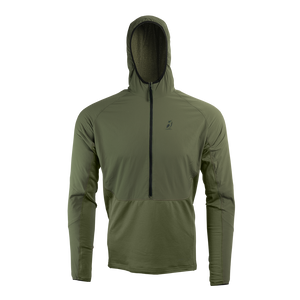
The Ventus is the lightest of the three at 7 oz in a medium, and it stuffs into its own inner pocket at about the size of a grapefruit. It carries 25 g/m² of 3DeFX insulation, which stretches as you move and lets more heat through, then lofts & retains heat when you stop. Perforated underarm vents and a 20D ripstop shell with a DWR finish make it a versatile layer for a range of conditions.
It's a light midlayer for moderate activity, like day hikes on cool mornings and steady miles on a backpacking trip. It's cut athletic, with room for a base layer and nothing more, and it has no hand pockets, so it sits flat under a hip belt and under the Nebo or Tushar. In mild climates it works as a light insulator by itself, comfortable somewhere around 25 to 50°F depending on how hard you're working.
"I hiked in the 30's and 40's while staying completely comfortable even in 20 mph winds. Then hiked in the high 50's up a mountain on the Appalachian trail and stayed perfectly comfortable without sweating that much."
Larry J., verified buyer
Vario Jacket

The Vario is the warmest of the three on our scale. It takes the Ventus design and adds more insulation (40 g/m² of 3DeFX, 50% recycled), a full YKK zip and two zippered hand pockets. It weighs 9 oz in a medium and keeps the perforated underarm vents, insulated hood and thumb loops.
That extra warmth + venting options are what lets it stay on for active hiking in winter conditions. The full zip lets you open it up on a climb without taking it off & perforated underarm vents help you regulate your temperature. The fit is trim, with room for a base layer and a light midlayer. In milder weather it's a three-season outer layer, and on cold nights it goes under a down jacket. On a lot of trips it ends up being the layer you hike in and the one you wear around camp.
"The NovaPro is my static wear. This is my active wear to effectively shed the sweat while hiking and yet keep me warm. ... I can either layer this under my NovaPro at camp, or switch the coats out after I get to camp."
Grant, verified buyer
Pursuit Hybrid Fleece

The Pursuit is for long, cold days where you never really stop working, like hunting approaches, alpine starts, ski touring and cold trail runs. It breathes the most of the three. Grid fleece (200 gsm) covers the underarms and shoulders, where heat and sweat build up fastest, and the 30D stretch-woven nylon face has 50 CFM of air permeability, so it cuts wind while still letting air through. PrimaLoft® Evolve insulation (75 g/m²) sits across the chest and back to hold warmth when you slow down.
It weighs 9.4 oz in a medium, with a half zip, a fitted hood, thumb loops and a dropped rear hem. It's designed to be worn all day below 40°F while you're moving, without stopping to shed layers on every climb. The fit is athletic, over a base layer, and it comes in tall sizes. In our Mountain Pursuit Line, it's the midlayer that goes under the Vantage and a shell.
"Really light jacket that works both to hike in and hang out with at camp. Almost like a microgrid/fleece with a windbreaker in one. ... Can work as a mid layer in colder weather or an outer layer 40-60F."
Andrew W., verified buyer
Shop the Pursuit Hybrid Fleece
Zulu, NovaPro or Vantage: which down jacket fits your trips?
The Zulu covers most three-season trips at 11 oz. If your trips tend to be wet, get the NovaPro. If you're planning for more cold and wind above treeline, get the Vantage.
Down jackets are for when you stop making heat: breaks, camp, early starts, a summit. The shells are Zero Stitch™ fabric, which forms the baffles without stitching through the shell, so there are fewer holes for wind and moisture to work through. They're cut with room to go over your active layer.
Zulu Down Jacket

The Zulu is our lightest down jacket, 11 oz in a medium, with 102g of 900 fill power Muscovy duck down in a 15D Zero Stitch™ shell. We designed it to ride along on 80 to 90% of backpacking trips, and it's comfortable from about 30 to 55°F with the right layers under it.
The features stop at two zippered hand pockets, two big internal drop pockets, a drawcord hem, a dropped rear hem and an elastic hood. The hood doesn't adjust, which saves weight. If you want a hood you can cinch down in wind, the NovaPro and Vantage both have one.
While it's not the lightest down jacket on the market, we believe it's the lightest down jacket worth making. Down is meant to insulate you when your body isn't generating heat anymore. The Zulu achieves the warmth levels required for that - milder conditions can be handled by your midlayer.
"I wore the Zulu over my Ventus in the Blue Ridge in early April. Temps at night near freezing and this combination was perfect. I liked how fast the pockets warmed my hands and kept my core toasty."
Special K, verified buyer
NovaPro Jacket

Wet down loses its loft, and the NovaPro was designed around that problem. Its DownLT™ insulation is 850 fill HyperDry™ down blended with a small amount of synthetic fill, and it stays lofted even when it's soaked. The Nova Zero Stitch™ fabric is made by weaving the I-tube baffles right into the shell, which leaves 10,000 fewer stitch holes than a typical puffy, and the 20D shell has a DWR finish.
At 14.5 oz in a men's large, it has more features than our other three-season puffies. You get pit zips, thumbholes, insulated zippered hand pockets, a two-way adjustable hood and a drop back, and it packs into its own pocket to use as a pillow. While not an intended use-case, some owners keep it on while moving on cold days because of the pit zips. If snow, sleet or a wet tent show up on your trips, this is the down jacket to bring.
"Hiked Hole 2 Hump (bottom of Grand Canyon to Mt Humphrey 65 miles) then road gravel bikes back 57 miles. Total 33hrs continuous. Days were 50's nights 20's. This puffy kept me warm the entire way. ... There was a chilly wind on bike ride back so I put puffy on and vented the arm pitts which made it comfortable by dumping the extra heat built up from riding."
J. Thayer, verified buyer
Vantage Alpine Down Jacket

The Vantage is for cold, still time in exposed terrain: glassing ridgelines at dawn, waiting out windchill on an exposed route, late-season camps above treeline. It's warmer than the Zulu or the NovaPro. A medium holds 203g of 850 fill ExpeDRY™ down in a 15D Zero Stitch™ shell and weighs 15.2 oz. ExpeDRY™ is a nanogold treatment that helps down dry faster and get its loft back sooner than DWR-treated down.
With the right layers it's comfortable from about 20 to 45°F (stationary). There are no pit zips, which saves weight and keeps heat in. It has a two-way adjustable hood, zippered hand pockets, internal drop pockets and a cinch hem. It's roomy enough to go over a Pursuit or Vario and a base layer, and it comes in women's sizing. In our Mountain Pursuit Line, it's the warmth layer.
"My daughter and I also like to hike the shoulder seasons. I needed a warm coat. This coat I took everywhere this year, and it held up and looks like new. More importantly, I was warm, warm, warm."
Mark F., verified buyer, Alaska
Shop the Vantage Alpine Down Jacket
Who needs the Resolve Down Anorak?
Hunters, photographers and anyone camping high in winter who spends hours sitting still below freezing. If you'll be moving, it's more jacket than you need.

It's the warmest piece of clothing we've made and the most specialized. For most people this jacket is overkill. The construction has more in common with a sleeping bag than a puffy. Box baffles give 850 fill power ExpeDRY™ down room to loft about 2.5 inches on each side, and a size large holds 365g of it. Instead of a full-length front zipper, which is a potential cold spot down your core, it has two half-length zippers with insulated draft tubes.
The top slider gives you access to a chest binocular harness or a camera while the rest of the front stays sealed. The bottom one dumps heat while the collar stays zipped at your chin. Together they make it easy to get on and off over your other layers. Both hands share one insulated kangaroo pocket, and the No. 5 YKK zippers have pulls you can work with gloves on.
A large weighs 24 oz, and nearly all of that is down and baffle structure. We don't publish a temperature rating for it. At 35°F with no wind, it may be more than you need. At 20°F in a 15 mph wind under cloud cover, it's in its element. Hike in it and you'll overheat quickly, so for warmth on the move, look at the Ventus, Vario or Pursuit.
The Resolve is the first piece from our Special Projects division, where we build for one narrow, high-consequence situation instead of broad use.
"Hope to see more OV Special Projects as this jacket is absolutely dialed in for intended use case of glassing in extreme cold. The long tail, large hood, bino harness accessibility etc are all well thought out, and more importantly well executed. I've had the jacket out 2x now in Montana and have been toasty both times."
Ian P., verified buyer
If you're adding one jacket this year, which should it be?
Look at what made your last trip uncomfortable and fix that first.
- No wind layer yet: the Nebo. It's the lightest thing we make and probably the one you'll wear most.
- Your rain jacket is heavy, clammy or soaking through at the shoulders: the Tushar.
- You sweat through your layers on the climb and get cold at the top: the Ventus to wear under a shell, or the Vario if you'd rather have one jacket with pockets.
- Cold, long, high-output days like fall hunts or winter approaches: the Pursuit.
- No camp puffy: the Zulu for most three-season trips, the NovaPro for wet ones, the Vantage for cold, high ones.
- You already own a good puffy but spend hours sitting still below freezing: the Resolve.
Used gear can't be returned, so try it on at home over the layers you'll actually wear before it goes on a trip.
What jackets should you pack for different mountain trips?
Pack for the coldest, wettest hour you expect, with separate layers for moving, for weather and for when you stop.
| Trip | While moving | Weather layer | Breaks & camp |
|---|---|---|---|
| Midsummer high country (Uintas, Winds, Sierra) | Base layer or sun hoodie | Nebo + Tushar | Zulu |
| September shoulder season | Ventus or Vario | Nebo + Tushar | Zulu or NovaPro |
| Wet ranges & stormy forecasts | Ventus | Tushar | NovaPro |
| Late-season hunts & fall above treeline | Pursuit Hybrid Fleece | Tushar | Vantage |
| Long glassing sits or winter cold camp | Pursuit Hybrid Fleece | Tushar | Resolve over your hiking layers |
How warm you run, the wind forecast and your sleep system will all shift these.
Frequently Asked Questions
Q: What's the difference between active insulation and a down jacket?
Active insulation, like the Ventus, Vario and Pursuit Hybrid Fleece, breathes and lets heat escape while you're working, so you can keep it on while you hike. A down jacket, like the Zulu, NovaPro or Vantage, holds as much heat as it can for its weight once you stop. Most mountain kits carry one of each.
Q: Can a windbreaker replace a rain jacket?
No. The Nebo Windbreaker blocks wind and its DWR finish sheds a light sprinkle, but it isn't waterproof. For steady rain you need a waterproof shell like the Tushar Rain Jacket. On dry, windy days, the Nebo breathes better and weighs about half as much.
Q: Which Outdoor Vitals jacket is the warmest?
The Resolve Down Anorak, made for long stretches of sitting still below freezing. Among our three-season down jackets, the Vantage Alpine Down Jacket is the warmest, comfortable from about 20 to 55°F with the right layers.
Q: What's the best Outdoor Vitals down jacket for three-season backpacking?
For most three-season trips, the Zulu Down Jacket. It weighs 11 oz in a medium, uses 900 fill power down and is comfortable from about 30 to 55°F with the right layers. If your trips tend to be wet, the NovaPro's DownLT™ insulation stays lofted even when soaked.
Q: Which Outdoor Vitals jackets are waterproof?
Only the Tushar Rain Jacket. The Nebo, Ventus, Vario and Pursuit have DWR-treated shells, and the down jackets use water-resistant Zero Stitch™ fabric, but none of them are waterproof.
Q: Should I size up to layer under an Outdoor Vitals jacket?
Order your normal size and check the fit notes on each product page. Our active layers fit close. The Ventus and Pursuit go over a base layer only, and the Vario has room for a base layer plus a light midlayer. The down jackets already have room to go over your other layers. The Tushar and Nebo use men's sizing.
Q: Which jackets come in women's sizing?
The Zulu, NovaPro, Vantage, Vario and Ventus all come in women's versions. The Tushar and Nebo use men's sizing, and their product pages show how they fit women.
Q: Can I return a jacket if it doesn't fit?
Yes, within 60 days if it's unused, and your first exchange is free. Used gear can't be returned, so try the fit at home before you take it into the field. Defects in gear you've used are covered separately under the Outdoor Vitals Performance Promise.
Tested in the mountains before it reaches your pack.
Shop Jackets & Mid-Layers | Compare Specs in the Performance Jacket Guide
About the Author
Derek, Marketing Director at Outdoor Vitals. Derek has been backpacking since he was 14, mostly in the Uintas and along the Colorado Trail through the San Juans. Closer to home, he spends a lot of time in the mountains around Cedar City, Utah, and in the Tushars near Beaver, the range our rain jacket is named for.
Mentioned in this article
More stories