


Durable Water Repellent (DWR) is a surface coating, and surface coatings wear off with use. Once it does, the waterproof membrane underneath, not the DWR, is what actually keeps you dry. Two membrane types exist (hydrophobic and hydrophilic), and they behave differently under a backpack, in heat, and over years of wash cycles.
This is the same territory covered in an earlier article for the community, 3 Things You Didn't Know About Your Ultralight Rain Jacket. This piece rebuilds that explanation in more depth and adds what that article did not: how membrane choice affects fit and layering, and how to care for a rain jacket so the membrane and DWR both last.
Key Takeaways
- DWR is a surface treatment, not a permanent one. It wears off through use, abrasion, and washing
- Once DWR fades, the waterproof membrane becomes the jacket's real line of defense
- Hydrophobic membranes block liquid water and stay breathable longer under sustained wet pressure
- Hydrophilic membranes swell to seal out water, which also closes off breathability as they absorb moisture
- Accelerated chamber tests compress about 10 years of hot, humid, salty wear into roughly 10 weeks
- The Tushar Rain Jacket pairs both membrane types by zone. See the full spec breakdown for the exact ratings.

Companion video: About Rain Jackets, featured alongside the original 3 Things You Didn't Know article.
In This Article
- Why Does a Rain Jacket Stop Repelling Water Even Though It Is Still Waterproof?
- What Is a Waterproof Membrane and How Is It Different From a DWR Coating?
- How Do Hydrophobic Membranes Keep You Dry Without Absorbing Water?
- Why Do Hydrophilic Membranes Feel Wet Even When No Water Gets Through?
- What Is the Internal Microenvironment Inside a Rain Jacket, and Why Does It Matter?
- How Does the Tushar Rain Jacket Combine Both Membrane Types in One Design?
- Does the Tushar Rain Jacket Fit the Same for Men and Women?
- What Should You Wear Under a Rain Jacket by Season?
- How Do You Wash a Rain Jacket Without Ruining the DWR or Membrane?
- Frequently Asked Questions
Why Does a Rain Jacket Stop Repelling Water Even Though It Is Still Waterproof?
DWR is a chemical coating applied to the outer fabric to make water bead up and roll off. It is a surface treatment, and surface treatments wear away with abrasion, dirt, and washing. That is physics, not a manufacturing defect.
When you see water beading up and rolling off a rain jacket, that is the DWR treatment doing its job. It sits on top of the face fabric and pushes water away before the fabric itself gets involved.
The comparison that holds up is sunscreen. You apply it, it works, and then it wears off over the course of a day whether or not you can see it happening. A rain jacket's DWR wears off the same way, and it wears off fastest in high-pressure areas such as where a backpack or shoulder straps sit.
The problem is not that DWR wears off. The problem is a jacket that relies on DWR as its main defense. Once that coating fades, a jacket built around DWR alone has no real backup. A jacket built around a waterproof membrane still has one.
What Is a Waterproof Membrane and How Is It Different From a DWR Coating?
A waterproof membrane is a thin, permanent barrier laminated to the inside of the face fabric. Unlike DWR, it does not wash off or wear away on the same timeline, and it is what actually stops liquid water from reaching you.
Think of the membrane less like a fabric and more like a coat of paint or a lamination bonded to the fabric behind it. It is typically microporous, which means it has openings small enough to block liquid water droplets while still letting water vapor pass through. That is the technical definition of breathable.
Membranes come in two functional types that behave very differently: hydrophobic and hydrophilic. Knowing which type is in a jacket, and where it is placed, tells you more about real-world performance than a waterproof rating on its own.
How Do Hydrophobic Membranes Keep You Dry Without Absorbing Water?
Hydrophobic membranes physically block water rather than absorbing it, which keeps them breathable for longer under sustained wet pressure, such as where a pack sits against your back.
Hydrophobic membranes do not let water pass through as liquid, and they do not absorb it either. Vapor is the only thing that gets through, which is exactly what you want from a jacket that also needs to breathe.
The tradeoff shows up over time rather than immediately. A hydrophobic membrane can be less breathable than a hydrophilic one in short, dry-ish conditions, but it holds that breathability more consistently once conditions get wet and stay wet, because it never has to fight its way back from being saturated.
Why Do Hydrophilic Membranes Feel Wet Even When No Water Gets Through?
Hydrophilic membranes absorb water and swell shut to block it, which also closes off the pathway that vapor would otherwise use to escape.
This sounds backward for something described as waterproof, but it works. Hydrophilic membranes absorb moisture, and the absorption causes the material to swell. As it swells, the microscopic pores close, similar to shutting a valve. Once the pores are closed, water cannot pass through.
The tradeoff is that the same swelling blocks vapor too. A hydrophilic membrane that has absorbed as much water as it can hold is described as wetted out. At that point, moisture from your own body, sweat and general evaporation, has nowhere to go. You will feel wet even though no outside water reached your skin, because the membrane is thin enough that saturation on one side reads as dampness on the other.
That trapped moisture does more than feel uncomfortable. It can also degrade the inside of the jacket over time, which is the subject of the next section.
Hydrophobic vs. hydrophilic, side by side:
| Feature | Hydrophobic Membrane | Hydrophilic Membrane |
|---|---|---|
| Mechanism | Physically blocks liquid water without absorbing it | Absorbs moisture and swells shut to block water |
| Best use zone | High-pressure areas: backpack straps, hip belt, hood | High-heat torso zones where breathability matters most |
| Breathability profile | Consistent under sustained wet pressure | High initially; drops once saturated ("wetted out") |
What Is the Internal Microenvironment Inside a Rain Jacket, and Why Does It Matter?
Body heat, sweat, and salt create a hot, humid, saline microenvironment inside a rain jacket, and that environment can chemically degrade membranes and seam tape faster than the weather outside does.
A rain jacket has to protect you from the rain, and it also has to survive what your own body does inside it. Movement generates heat and sweat. Heat naturally moves toward cooler areas, which is why a wet shirt dries even on a cloudy day, but inside a sealed rain jacket that same process traps humid, salty air against the membrane and seam tape instead of letting it escape.
Salt from sweat is the part people tend to miss. Saline moisture pressed against membranes and seam tape for hours at a time can do real chemical damage over months and years of use, independent of anything the weather is doing outside the jacket.
Fabric and membrane manufacturers test for exactly this. Accelerated aging chambers hold materials at high heat and humidity to simulate the internal microenvironment a jacket experiences on trail. A chamber test of about 10 weeks is designed to approximate roughly 10 years of that kind of real-world wear. A jacket that has been through this kind of testing, and holds up, is telling you something about durability that a spec sheet alone cannot.

Learn more here: About Rain Jackets, Hours in real storms are what create the internal conditions a jacket has to survive, not just the weather outside it.
How Does the Tushar Rain Jacket Combine Both Membrane Types in One Design?
The Tushar Rain Jacket uses a hydrophobic Toray TORAIN membrane in high-pressure zones and a hydrophilic TORAIN membrane in high-heat zones, so each membrane type is doing the job it is actually good at.
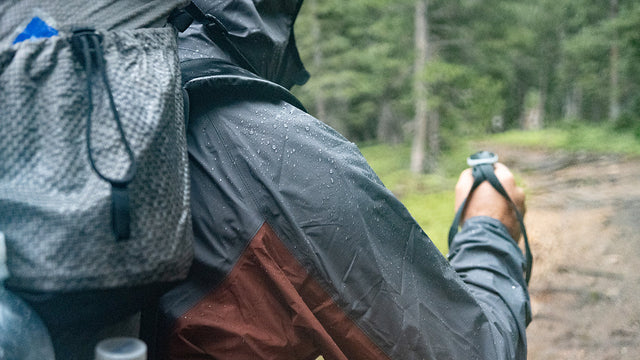
Rather than picking one membrane type for the whole jacket, the Tushar maps both types to specific zones of the body. The hydrophobic membrane sits where a backpack, hip belt, or shoulder straps press against the fabric for hours at a time, the zones most likely to see sustained wet pressure. The hydrophilic membrane sits in the torso areas where your body generates the most heat, where breathability matters more than resisting constant pressure.
That pairing is a direct, practical answer to the two failure modes described above: a membrane that is only hydrophobic can feel less breathable in high-heat zones, and a membrane that is only hydrophilic can wet out in high-pressure zones. Body-mapping both types is how the Tushar avoids choosing one weakness over the other.
A full breakdown of the Tushar's fabric weights, HH waterproof ratings, and durability testing is covered in the complete Tushar Rain Jacket spec blog. The short version: this is the same membrane science explained above, applied to a specific 7.4 oz jacket.

Sealed zippers and mapped membranes both exist to manage the same problem: keeping the inside of the jacket dry, not just the outside.
Does the Tushar Rain Jacket Fit the Same for Men and Women?
Yes, with normal size adjustment. The Tushar is built in men's sizing, but the athletic cut works for women who size accordingly, and Outdoor Vitals publishes fit photos on women for reference before you order.
Membrane placement is the same regardless of who is wearing the jacket. Body-mapping is based on where a pack sits and where the body generates heat, both of which are consistent across builds. What changes person to person is simply sizing.
The athletic cut tapers through the torso rather than boxing you in, and the anatomically cut hood adjusts to work with or without a hat underneath. Because the jacket runs in men's sizing, women generally do best sizing down from their usual jacket size rather than matching the number directly. Outdoor Vitals includes fit photos on women on the product page for exactly this reason, so you can compare against your own frame before ordering.
Real fit data backs this up on both sides. Independent reviewer Sean Sewell, 6 ft 1 in with a 45 in chest and 33 in waist, wore a men's XL and called it "a really spot-on fit," noting there is not much room for extra layers underneath and that he would size up to fit a puffy jacket under the shell.

A published fit reference removes the guesswork of ordering men's sizing as a woman.
What Should You Wear Under a Rain Jacket by Season?
Layer for moisture management, not just warmth: a moisture-wicking base layer in warm weather, an added insulating mid-layer in shoulder season, and a warmer mid-layer plus liner gloves and a buff in winter, all worn under the same shell.
A rain jacket's membrane can only move so much vapor at once, so what you wear underneath affects how dry and comfortable you stay as much as the jacket itself does. The goal in every season is to keep as much moisture as possible moving away from your skin before it ever reaches the membrane.
- Warm weather: a light, moisture-wicking base layer or just a t-shirt, worn under the shell, and pit zips open whenever you are moving
- Shoulder season: a light or midweight insulating layer added between the base layer and the shell, so you can shed it during climbs and add it back at breaks
- Cold or winter conditions: a warmer insulating mid-layer under the shell, since the Tushar is a rain shell and not an insulated jacket on its own, plus liner gloves and a buff to manage heat loss at the extremities
For a complete season-by-season system rather than a single jacket, the Outdoor Vitals Adaptive Layering System walks through how base layers, mid-layers, and shells are meant to work together across a full year of conditions.
How Do You Wash a Rain Jacket Without Ruining the DWR or Membrane?
Wash a rain jacket in a machine without an agitator on a cold, delicate cycle using a technical cleaner such as Nikwax Tech Wash instead of regular detergent, then hang dry. Regular detergent residue coats the membrane and reduces performance.
Dirt, body oil, and detergent residue all sit on top of the DWR and membrane the same way water is supposed to, which blocks the coating from doing its job and accelerates the exact wear this article started with. Cleaning correctly is what keeps a jacket's DWR and membrane performing anywhere close to their original numbers.
- Use a washing machine without an agitator, set to cold on a delicate cycle
- Zip up all zippers first so nothing catches during the wash
- Use a technical cleaner such as Nikwax Tech Wash instead of regular detergent, which protects seam tape and membrane performance
- Run an extra rinse cycle; leftover detergent residue on the jacket reduces waterproofing and breathability
- Hang dry only; skip the dryer, since heat wears DWR off faster and adds unnecessary stress to seams
- Keep the jacket away from DEET-based bug spray and oils, which can permanently damage synthetic face fabrics
DWR can be reactivated once it has worn down, typically with a spray-on or wash-in product following the technical cleaner. Full step-by-step instructions, including down and synthetic gear care, are in the Outdoor Vitals Care Guide FAQ.
If you are deciding between a rain shell and a windbreaker for a given trip, the tradeoffs are different from anything above: Windbreakers vs. Rain Jackets covers that comparison directly.
The Tushar Rain Jacket is available now in North Atlantic and Cherry Mahogany.
Available in men's sizing, with published fit photos for women.
Shop the Tushar Rain Jacket | Shop Men's Apparel | Shop Women's Apparel
Frequently Asked Questions
Q: What is DWR and why does it wear off?
DWR (Durable Water Repellent) is a chemical coating applied to a jacket's outer fabric that makes water bead up and roll off. It is a surface treatment, not a permanent one, so it wears down with abrasion, dirt, and washing over time. This is expected behavior, not a defect.
Q: What is the difference between a hydrophobic and hydrophilic membrane?
A hydrophobic membrane blocks liquid water without absorbing it, which keeps it breathable under sustained wet pressure. A hydrophilic membrane absorbs water and swells to close its pores and block water, but that same swelling reduces breathability as it absorbs more moisture.
Q: Why does a rain jacket feel wet inside even when no water gets through?
This usually means a hydrophilic membrane has wetted out, meaning it has absorbed as much moisture as it can hold. Once saturated, your own sweat and body moisture cannot pass through either, so the inside feels damp even though outside water never reached your skin.
Q: What is a Jungle Test and why does it matter for rain jacket durability?
A Jungle Test (or similar accelerated aging chamber test) holds jacket materials at high heat and humidity to simulate the internal microenvironment created by body heat and sweat over years of use. Roughly 10 weeks in the chamber is designed to approximate about 10 years of real-world wear on membranes and seam tape.
Q: Can I wash my rain jacket without ruining the waterproofing?
Yes, if you wash it correctly. Use a washing machine without an agitator on a cold, delicate cycle, use a technical cleaner such as Nikwax Tech Wash instead of regular detergent, run an extra rinse, and hang dry. Regular detergent residue and dryer heat both accelerate DWR and membrane wear.
Q: Does the Tushar Rain Jacket fit women as well as men?
The Tushar is built in men's sizing, and the athletic cut works well for women who size down accordingly. Outdoor Vitals publishes fit photos on women on the product page so you can compare fit before ordering.
Q: What should I wear under a rain jacket in cold versus warm weather?
In warm weather, a light moisture-wicking base layer or t-shirt is usually enough, with pit zips open while moving. In cold or winter conditions, add a warmer insulating mid-layer underneath, since a rain shell like the Tushar is not insulated on its own, plus liner gloves and a buff for the extremities.
Q: How often should I reapply DWR to my rain jacket?
There is no fixed schedule. Reapply DWR when water stops beading up and instead soaks into the face fabric. Most technical cleaners pair a Tech Wash step with a separate DWR reactivation step, applied after cleaning rather than on its own.
About the Author
Derek Rasmussen
Content Lead, Outdoor Vitals
Derek Rasmussen is the content lead at Outdoor Vitals and a dedicated long-distance backpacker based in southern Utah. He has logged thousands of trail miles across the American West, from multi-day sections of the Colorado Trail to routes through the Tushar Mountains where Outdoor Vitals gear is field-tested. Every piece he writes is grounded in firsthand experience with the gear, not specs pulled from a box.
Learn more about the Outdoor Vitals team | Follow founder Tayson Whittaker at taysonwhittaker.com
Mentioned in this article
More stories
Can the Tushar Rain Jacket Keep You Dry Through All-Day Mountain Storms?