

Most rain jacket disappointment does not come from a bad jacket. It comes from buying without knowing what to check, then blaming the jacket when it does exactly what its price point and design were always going to do. A hydrostatic head number on a hang tag does not tell you whether a jacket will actually keep you dry on a real trip.
This guide covers what to verify before you buy: which claims are marketing, which numbers actually matter, what features to check with your own hands, and how to wear the jacket so it performs the way its spec sheet promises. The Outdoor Vitals Tushar Rain Jacket is used as the working example throughout, evaluated against the same checklist rather than exempted from it.
Key Takeaways
The buying checklist, before you look at a single jacket:
| Check This | What to Look For | Why It Matters |
|---|---|---|
| Waterproof rating | At least 10,000mm HH for occasional rain; 20,000mm+ for sustained wet climates | Low ratings wet out fast under pack straps and sustained rain |
| Venting | Pit zips, not just a breathable membrane claim | A membrane only vents when outside air is not already saturated |
| Hood, cuffs, hem | Adjustable or well-elasticized at all three | Loose points let wind-driven rain and drafts in |
| Fit for layering | Room to wear a mid-layer, not just a t-shirt | A shell that is too tight under-layers defeats its own purpose |
| Weight and pack size | Packs down small enough that you will actually bring it | A rain jacket left at home because it was too bulky protects no one |
| DWR and care | A washable, reactivatable coating; ask what it is made of | DWR wears off on every jacket. What happens after that is what separates jackets |

A rain jacket earns its reputation on the days you did not plan for, not the ones you did.
In This Article
- Is a Rain Jacket Ever Truly "Permanently" Waterproof?
- Does a Rain Jacket Only Leak Because It Has a Hole in It?
- Should a Truly Waterproof Rain Jacket Not Be Breathable?
- What Hydrostatic Head Rating Should You Actually Look For?
- Why Do Pit Zips Matter More Than the Number on the Tag?
- What Should You Check on the Hood, Cuffs, and Hem Before You Buy?
- Does the Jacket Actually Fit Over a Mid-Layer?
- How Should You Actually Wear a Rain Jacket So You Stay Dry?
- Does the Tushar Rain Jacket Hold Up Against This Checklist?
- Frequently Asked Questions
Is a Rain Jacket Ever Truly "Permanently" Waterproof?
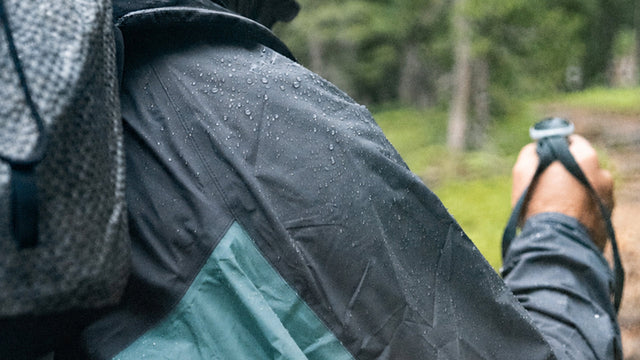
No. Every rain jacket's outer coating, called DWR (Durable Water Repellent), wears off with abrasion, dirt, and washing. This is true of every jacket at every price point, not a defect in any one of them.
This is myth number one in Outdoor Vitals founder Tayson Whittaker's own breakdown of common rain jacket misconceptions: that a rain jacket, once purchased, stays permanently waterproof. It does not, and no amount of money spent changes that. What separates jackets over time is not whether the DWR wears off. It is whether the jacket still has a real waterproof membrane doing the work once the coating fades, and whether the DWR can be reactivated when it does.
A deeper breakdown of DWR mechanics, membrane types, and how to care for a jacket so both last is covered in Outdoor Vitals' rain jacket breathability and care guide. The short version for buying purposes: ask whether the jacket relies on DWR alone, or has a membrane backing it up.
Does a Rain Jacket Only Leak Because It Has a Hole in It?
No. A jacket can feel wet and clammy with zero holes in it, because a saturated hydrophilic membrane blocks vapor from escaping the same way it blocks water from entering.
This is one of the more persistent myths in rain gear: that feeling wet on the inside means the jacket is leaking. In many cases, the membrane is still fully waterproof. What has happened is that a hydrophilic membrane has absorbed as much moisture as it can hold, its pores have swollen shut, and now nothing, including your own sweat, can pass through in either direction. That reads as wet skin, even though no outside water got in.
This distinction matters when you are troubleshooting a jacket that feels wet on trail. Before assuming it is defective or punctured, consider whether it is actually wetted out from the inside, a normal failure mode rather than a manufacturing problem.
Should a Truly Waterproof Rain Jacket Not Be Breathable?
No. A rain jacket has to be breathable to function at all. The confusion is what breathable means: it is breathable to water vapor, not to air you could blow through it.
A completely non-breathable jacket is just a plastic bag with sleeves. It would keep rain out and trap every bit of your own sweat and body heat inside with you. Breathability ratings describe how efficiently a membrane transfers moisture vapor from inside the jacket to the outside air, not literal airflow. A high breathability number means better vapor transfer, which is what actually keeps you from feeling clammy on a climb.
The catch buyers should know: breathability drops sharply once the outside air is already saturated, such as during sustained rain, because vapor transfer depends on a difference in humidity between the inside and outside of the jacket. No membrane, at any price, breathes well in a downpour with no airflow. That is what makes the next few sections about pit zips and venting technique matter more than most buyers expect.

Source video: 3 Myths About Rain Jackets, Tayson Whittaker, Outdoor Vitals.
What Hydrostatic Head Rating Should You Actually Look For?
Look for at least 10,000mm hydrostatic head (HH) for occasional rain in mild climates, and 15,000 to 20,000mm or higher if you hike somewhere with sustained, heavy, or cold rain.
Hydrostatic head measures how much water pressure a fabric can resist before it leaks, tested in millimeters of standing water. It is a real, useful number, but it is not the only number that matters, and a higher HH rating on the tag does not mean a jacket will out-perform a lower-rated one in the field if the DWR is already failing or there are no pit zips.
Use HH rating as a floor, not a ranking. A 10,000mm jacket in good condition with functioning DWR will handle most day-hiking rain. A jacket built for backpackers who face sustained, all-day storms should sit meaningfully higher than that floor, and should back it up with seam-taping and membrane durability testing, not just the number on the tag.
Why Do Pit Zips Matter More Than the Number on the Tag?
Because a membrane only breathes when there is a humidity difference between the inside and outside of the jacket, and pit zips are the only feature that moves air when that difference disappears.
Rain jackets fail in three distinct ways, and the number on the tag only addresses one of them. First, real leaks: if the seams are taped and the DWR has not failed, most jackets in this category keep rain out for a while. Second, and far more common: your own sweat outpaces what the membrane can vent, especially on a climb, so you end up just as wet from the inside as you would have been from the outside. Third: contact moisture from wet brush, snow-covered scrub, and stream crossings gets in around cuffs, hems, and pack straps no matter what the tag says.
Most buyers shop for the first failure mode and ignore the second, which is usually the one that actually ruins a trip. Pit zips exist specifically to address it: opening them creates direct airflow that moves heat and moisture out mechanically, instead of waiting on a membrane that has already run out of room to vent passively.
Check for pit zips by hand before you buy, not just by reading the spec sheet. A jacket with a high waterproof rating and no venting will still leave you soaked in sweat on a hard climb.
What Should You Check on the Hood, Cuffs, and Hem Before You Buy?
Check that the hood, cuffs, and hem all seal or adjust well. A jacket that is excellent everywhere else but loose at these three points will still let in wind-driven rain and drafts.
- Hood: should stay in place during movement and work with or without a hat, without needing constant readjustment
- Cuffs: should seal at the wrist without letting water run up your sleeve, whether that is with a drawcord, velcro, or elastic
- Hem: should cinch or grip at the sides so the jacket does not ride up over a pack's hip belt or lift in wind
- Pockets: at least one that is genuinely useful in the rain, positioned so it does not conflict with a hip belt or pack strap
- Zippers: sealed or storm-flap covered, since an unsealed main zipper is a direct line for water
These are the details you can only really evaluate by handling the jacket, which is why a spec sheet alone is not enough to buy from. If you are ordering online, read the product's own feature list carefully rather than assuming every ultralight shell includes all five.

Sealed zippers are a detail worth checking by hand, not just reading about.
Does the Jacket Actually Fit Over a Mid-Layer?
It should fit with room for at least a light mid-layer underneath, not just over a bare shirt, or it will force you to choose between warmth and rain protection.
A rain shell that only fits over a t-shirt looks good in a size chart but fails the moment temperatures drop. You need room to add a fleece or light insulating layer underneath without the shell pulling at the shoulders or riding up at the hem, since a tight shell also compresses insulation and reduces its warmth.
At the same time, oversizing a shell adds unnecessary bulk and weight, and loose fabric flaps in wind. The fit you want sits close enough to layer a pack comfortably over it, with enough room underneath for one insulating layer without feeling restrictive.

A published fit photo, with real measurements attached, is worth more than a size chart alone.
How Should You Actually Wear a Rain Jacket So You Stay Dry?
Put the shell on before you are already wet, open every vent immediately, shed a layer underneath, and keep adjusting as your effort level changes. How you wear a rain jacket affects dryness as much as the jacket itself.
The single most common mistake is waiting too long to put the shell on, then overheating inside it once it is on. Once you are already damp, from either rain or sweat, the jacket traps that moisture and you are working from a deficit for the rest of the day.
- Put the shell on before you need it, while you are still dry, if rain or wet brush is visibly coming
- Open pit zips and the main zip partway immediately, before heat and moisture build up inside
- Remove or reduce an insulating layer underneath when the shell goes on; less insulation means less sweat
- Keep adjusting throughout the day. Open vents further on climbs, close up and add a layer at stops, and expect to make these adjustments repeatedly on a long day
None of this requires a more expensive jacket. It requires treating the shell and your layers underneath as one adjustable system instead of a single piece of gear you put on once and forget about.
Does the Tushar Rain Jacket Hold Up Against This Checklist?
Largely yes, measured against the checklist above rather than against marketing claims. The Tushar meets or exceeds most items, with fit as the one point worth sizing carefully for.
- Waterproof rating: the Tushar's two membrane zones are rated 28,500mm HH and 15,500mm HH, both well above the 10,000 to 20,000mm range recommended above
- Venting: pit zips are included as standard, not an upgrade option, addressing the sweat-based failure mode directly
- Hood, cuffs, hem: an anatomically cut hood, half-elasticized cuffs, and a partial elasticized hem for fit, per the product's own spec sheet
- Fit for layering: runs true to size for a base layer or light mid-layer; an independent reviewer at 6 ft 1 in with a 45 in chest wore a men's XL and called it a spot-on fit, but noted he would size up specifically to fit a puffy jacket underneath. Size up if bulky mid-layer insulation is part of your plan
- Weight and pack size: 7.4 oz in a size Large, packing down to roughly fist-size in its own chest pocket
- DWR and care: the DWR is a standard wearable coating, expected to wear down like any other, with reactivation and washing instructions in Outdoor Vitals' Care Guide FAQ
One checklist item this piece raised, jacket color for visibility, is worth a direct answer rather than a forced one: the Tushar ships in North Atlantic (deep blue) and Cherry Mahogany (deep red), not high-visibility brights. If backcountry visibility is your top priority over color preference, pair it with a brightly colored pack or accessory rather than expecting the shell itself to solve that.
Full spec numbers, fabric details, and durability testing are covered in the complete Tushar Rain Jacket spec blog. Full membrane science and care instructions are covered in the breathability and care guide.

Fit that works over a mid-layer is a checklist item you can only confirm by trying it on.
The Tushar Rain Jacket is available now in North Atlantic and Cherry Mahogany.
Check it against your own checklist before you buy, not just this one.
Shop the Tushar Rain Jacket | Shop Men's Apparel | Shop Women's Apparel
Frequently Asked Questions
Q: Is a more expensive rain jacket always a drier one?
Not automatically. Price often reflects fabric weight, brand, and features, but a lower-cost jacket with a functioning DWR, a real membrane, and pit zips can outperform a pricier jacket with none of those in good working order. Check the specific jacket's specs and condition rather than assuming price equals performance.
Q: What hydrostatic head rating is actually good enough?
At least 10,000mm HH for occasional rain in mild conditions, and 15,000 to 20,000mm or higher for sustained or heavy rain and cold, wet climates. Treat the number as a minimum floor, not a full performance guarantee, since DWR condition and venting affect real-world dryness just as much.
Q: Why does my rain jacket feel wet inside even though it has no holes?
This is usually a wetted-out membrane, not a leak. A hydrophilic membrane absorbs moisture until its pores swell shut, which blocks both incoming water and outgoing vapor. You end up feeling wet from trapped sweat, not from water getting through the fabric.
Q: Do I really need pit zips on a rain jacket?
If you hike or backpack with any real exertion, yes. Pit zips are the only feature that moves air mechanically once the outside air is already too saturated for a membrane to vent passively, which is exactly when you need airflow the most.
Q: How do I know if a jacket will fit over a mid-layer?
Check the brand's own sizing notes and fit photos, and consider sizing up if you plan to wear a thicker mid-layer such as a puffy jacket underneath. A shell that is fitted for a base layer alone may feel tight once you add real insulation.
Q: Is DWR wearing off a sign of a defective jacket?
No. DWR wears off on every rain jacket at every price point through normal abrasion, dirt, and washing. It is expected behavior. What matters is whether the jacket still has a functioning waterproof membrane underneath, and whether the DWR can be washed and reactivated.
Q: Does the Tushar Rain Jacket meet this buying checklist?
Yes on waterproof rating, venting, hood and cuff and hem design, weight, and DWR care. On fit, it runs true to size for light layering, though an independent reviewer noted sizing up if you plan to wear a bulkier mid-layer underneath. It does not ship in high-visibility colors, only North Atlantic and Cherry Mahogany.
About the Author
Derek Rasmussen
Content Lead, Outdoor Vitals
Derek Rasmussen is the content lead at Outdoor Vitals and a dedicated long-distance backpacker based in southern Utah. He has logged thousands of trail miles across the American West, from multi-day sections of the Colorado Trail to routes through the Tushar Mountains where Outdoor Vitals gear is field-tested. Every piece he writes is grounded in firsthand experience with the gear, not specs pulled from a box.
Learn more about the Outdoor Vitals team | Follow founder Tayson Whittaker at taysonwhittaker.com
Mentioned in this article
More stories

What Actually Keeps a Rain Jacket Dry After the DWR Wears Off?