

The Tushar Rain Jacket is a 7.4 oz ultralight shell built for backpackers who face real weather. It uses Toray TORAIN body-mapped waterproof membranes, a 3D-printed interior half layer, and fully seam-taped construction to stay waterproof and breathable on full-day hikes in sustained storms. Outside Magazine named it “Best Lightweight Backpacking Shell,” a third-party recognition of that design approach.
Most ultralight rain jackets make a trade: cut weight by using the lightest possible single membrane, and that membrane starts to fail under sustained pack pressure and high-exertion heat. The Tushar is designed around a different idea. Two different membranes are mapped to where your body needs waterproofing and where it needs breathability. The face fabric is durable enough to handle backcountry terrain. Pit zips are included because the jacket is built for hikers who stay in it, not hikers who take it off the moment they start sweating.
Named after the Tushar Mountains in Utah, where the Outdoor Vitals team logged hours in high-elevation storms during development, this jacket earned its name on the same terrain it was built for.
Key Takeaways
- 7.4 oz (size Large), packs to fist-size in its own chest pocket
- Toray TORAIN 2.5-layer waterproof breathable lamination with 3D-printed interior half layer (5g vs 30g for a standard backer)
- Body-mapped dual membranes: 28,500mm HH hydrophobic in high-pressure zones, 28,900g breathability hydrophilic in movement zones
- 20D micro-ripstop nylon face fabric, fully seam-taped with TORAIN-specific seam tape tested past 10 years in the Jungle Test
- Pit zip vents, anatomically cut hood, YKK Aquaguard waterproof zippers, half-elasticized cuffs
- Named “Best Lightweight Backpacking Shell” by Outside Magazine

The Tushar Rain Jacket: body-mapped waterproof membranes, 20D face fabric, and a 7 oz build.
In This Article
- Why Do Most Ultralight Rain Jackets Fail on Long Days in the Rain?
- What Is TORAIN Technology and Why Does It Make the Tushar More Reliable?
- How Does Body-Mapped Membrane Design Keep You Dry and Comfortable at the Same Time?
- How Does the Tushar Stay Breathable While You Are Actively Hiking?
- Is the Tushar Rain Jacket Durable Enough for Rugged Backcountry Terrain?
- What Does the Tushar Weigh and How Small Does It Pack?
- Who Is the Tushar Rain Jacket Built For?
- What Are Real Users Saying About the Tushar in the Field?
- Frequently Asked Questions
Why Do Most Ultralight Rain Jackets Fail on Long Days in the Rain?
Most ultralight shells fail because a single thin membrane wets out under pack pressure and cannot vent heat during active hiking, forcing a choice between staying dry and staying comfortable.
The standard approach in ultralight rain jacket design is to minimize weight by using the lightest possible membrane. That works on short hikes where you put the jacket on to wait out a storm and then take it off. It stops working when you are covering 20 miles in rain that lasts all day, which is exactly the scenario a rain jacket for thru-hiking has to survive.
A pack pressing against a single membrane for hours saturates it faster than normal. Once the outer DWR treatment fades, water migrates through and the jacket starts to feel damp from the inside. You cannot tell if it is condensation or if the jacket is leaking.
Breathability is the second failure point. Ultralight membranes transfer vapor, but only when conditions are right. On a cold, rainy day when you are hiking hard, the temperature and pressure differential that drives vapor transfer disappears. Heat builds inside and you get clammy regardless of what the spec sheet says.
The Tushar approaches both problems differently. The membrane is not uniform. It is mapped to your body based on where you need waterproofing and where you need to breathe. And rather than relying on membrane transfer alone, the jacket includes pit zips so you can dump heat actively when the conditions do not allow passive transfer.
Pushing Limits: Tushar Rain Jacket | Outdoor Vitals — Tayson field testimonial: 62-mile fastpack on the Skyline and 100-mile Highline route in sustained weather.
What Is TORAIN Technology and Why Does It Make the Tushar More Reliable?
TORAIN is Toray’s proprietary waterproof breathable lamination system. Its fabric and seam tape are engineered to bond to each other specifically, not to a generic membrane, which is why the system has exceeded 10 years of simulated field use without degradation.
Toray is one of the most respected fabric suppliers in the outdoor industry. TORAIN waterproof technology is not a generic waterproof label. It is a specific lamination system where the membrane and seam tape are co-engineered to bond together at the molecular level rather than just adhere on the surface.
The difference shows up in the Jungle Test. This test holds fabric in a chamber at 170 degrees with maximum humidity. Each week in the chamber equals one year of real-world trail use. Competitor fabrics and tapes deteriorated during the test. The TORAIN system in the Tushar passed the 10-year mark and continued without signs of degradation.
Standard rain jackets use seam tape designed to work with any membrane, which means it is optimized for none of them. The Tushar uses TORAIN-specific seam tape, engineered for the best possible adhesion to the exact lamination in this jacket. That specificity is what gives the seams their long-term reliability across hundreds of miles and many wash cycles.

The Jungle Test: after 10 simulated years, TORAIN materials in the Tushar showed no signs of degradation.
How Does Body-Mapped Membrane Design Keep You Dry and Comfortable at the Same Time?
The Tushar uses two TORAIN membranes in specific zones: a hydrophobic membrane in high-pressure, high-abrasion areas, and a hydrophilic membrane where breathability matters most. Both are fully waterproof.
A single membrane has to compromise. Make it more waterproof and you sacrifice breathability. Maximize breathability and you reduce protection in the zones where a backpack and rain hit hardest. That compromise is why a genuinely breathable rain jacket for backpacking is so hard to find.
The Tushar solves this with body-mapping. The hydrophobic membrane sits in zones where shoulder straps press water into the fabric and where rain hits with the most force. This membrane resists water migration even when DWR fades, because it blocks liquid water under pressure rather than just beading it up.
The hydrophilic membrane goes into torso zones where your body generates the most heat. Hydrophilic means water-attracting at the vapor level, which allows moisture in gas form to pass through while still blocking liquid water from outside. The result is complete waterproofing where you need it most and real breathability where your body needs to move heat out.
On the inside, a 3D-printed half layer keeps the membrane off your skin. The 3D print weighs 5 grams. A standard 2.5-layer treadle backing weighs 30 grams for the same function. By choosing the 3D-print approach, Outdoor Vitals saves 25 grams in the liner alone, which is what makes the 20D face fabric on the outside achievable at a 7 oz weight target.

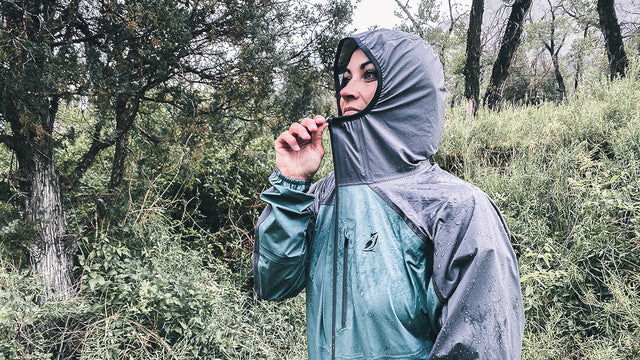
Beading in sustained rain: the 20D micro-ripstop face fabric and YKK Aquaguard chest zipper up close.
How Does the Tushar Stay Breathable While You Are Actively Hiking?
The Tushar uses pit zips as its primary active breathability system because waterproof membranes transfer vapor but cannot move bulk heat fast enough during high-exertion hiking without a physical opening.
Waterproof membranes are breathable in the technical sense: they transfer moisture vapor through a pressure differential. When you are hiking hard in cold rain, that differential is difficult to achieve. Heat builds. A breathable membrane helps but does not solve the problem alone.
Pit zips solve it. Opening the underarm vents creates direct airflow into the jacket, which drops core temperature fast and eliminates the clammy buildup that makes hikers want to remove their rain jacket in the middle of a storm. For that reason, Outdoor Vitals treats pit zips as non-negotiable in the Tushar design, even at the cost of a small weight addition.
The full feature set, at a glance:
- Pit zip vents for direct airflow during high-exertion hiking
- Anatomically cut hood that stays in place during movement, over a hat or against the skin, without losing side coverage
- Half-elasticized cuffs that seal the wrist without velcro, and a partial elasticized hem that keeps the jacket down over your back on steep terrain
- One chest pocket that doubles as the stuff sack (packs to fist size)
- YKK Aquaguard waterproof zippers on every opening: main zip, chest pocket, and pit zips
- Hydrophobic membrane in pressure zones (shoulder straps, hip belt), hydrophilic membrane in heat zones
- 3D-printed interior half layer that keeps the membrane off your skin at 5g instead of a 30g standard backer

Pit zip vents: direct airflow when membrane transfer alone cannot keep up.
Is the Tushar Rain Jacket Durable Enough for Rugged Backcountry Terrain?
Yes. The 20D micro-ripstop nylon face fabric gives the Tushar durability well above most ultralight shells in this weight class, and the TORAIN 3D-print interior is what makes that heavier face fabric possible without busting the weight target.
Most ultralight rain jackets in the 7 oz range use 7D or 10D fabrics. These save weight but degrade quickly under abrasion from a pack, brush, and scrambling. The Tushar uses 20D micro-ripstop nylon, which is significantly more resistant to abrasion. The ripstop grid prevents a tear from propagating across the weave, the same principle found in technical mountaineering shells at far higher price points.
Outdoor Vitals founder Tayson Whittaker documented this durability claim during development, not in a test lab. He tested the Tushar on a 62-mile fastpack across the Tushar Mountain range in two and a half days, through mud, rain, wind, and sustained abrasion near 12,000 feet. Immediately after, he headed to the Highline Trail for another 100-mile stretch with more extreme weather. After both trips, the team flipped the jackets inside out and inspected every seam and panel. His description was that the jacket looked pristine.
That is the kind of field test that tells you something real. Not a controlled chamber. Not a marketing shoot. Weeks of consecutive backcountry use in conditions that replicate exactly what the jacket’s buyers will face.
Tushar Rain Jacket Product Walkthrough | Outdoor Vitals — technical deep dive on materials and construction.
What Does the Tushar Weigh and How Small Does It Pack?
The Tushar weighs 7.4 oz in size Large, 7 oz in a Medium, and packs to roughly the size of a closed fist when stuffed into its own chest pocket.
At 7.4 oz, this 7 oz rain jacket class shell sits at the practical end of ultralight. It is heavier than a 4 oz emergency poncho, but it is a jacket you can hike in all day without taking it off. The extra weight over absolute-minimum options comes from the 20D face fabric and YKK Aquaguard waterproof zippers across all openings.
YKK Aquaguard zippers have a waterproof seal built into the zipper tape. They are heavier than standard coil zippers but do not require a separate zipper cover. At fist-size packed volume and under half a pound, the Tushar removes the calculation that leads hikers to leave their rain protection behind.
Who Is the Tushar Rain Jacket Built For?
The Tushar is built for backpackers who spend full days on trail in rain and need a shell that keeps up with their pace, not just their storm.
This jacket is not designed for standing at a trailhead or walking between the car and camp. It is designed for people who hike 15 to 25 miles in weather that shows up unannounced and stays longer than forecast. If you are comparing ultralight rain jackets for backpacking, that is the use case to judge the Tushar against.
- Thru-hikers on the PCT, CDT, AT, or long routes in alpine terrain who need reliable waterproofing across resupply gaps
- Fastpackers covering high mileage in technical terrain where abrasion resistance is as important as weight
- Weekend backpackers who consistently hike in weather and are tired of shells that feel damp inside after an hour
- Hikers building an ultralight system who want an ultralight waterproof jacket that layers cleanly without adding bulk
- Anyone replacing a heavier shell who wants to cut weight without cutting the rain protection they actually rely on
For hikers thinking about both rain protection and pack weight, the Carbon Evo 50 Backpack is the companion pack built for the same long-distance use case.

The anatomically cut hood: full coverage that stays in place, with or without a hat.
What Are Real Users Saying About the Tushar in the Field?
Real users consistently report that the Tushar keeps them fully dry without the clammy buildup common in other ultralight shells, including in conditions well outside a normal backpacking trip.
“I didn’t get clammy inside the jacket. I didn’t get that wetting out feel. I felt comfortable inside there and I was able to vent when the sun came out for a few minutes. Fit, cut, everything was just working together really well. After those trips we flipped them inside out and inspected every part of the jacket and they just looked amazing. This is an ultralight piece of gear that we ran in, had tons of abrasion in, took snow, rain, sleet, every element, and it just looks pristine still.”
Tayson Whittaker, Outdoor Vitals Founder
“I was out scraping ice off our driveway and road as freezing rain was falling. I had a grid fleece on underneath and grabbed my Tushar when it started freezing rain harder. I spent 90 minutes in it doing high exertion work and did not have any issues. The freezing rain did not force me inside. I stayed dry and warm. Even with it being about 25 outside. If it can handle this, it can handle my backpacking or camping in terrible weather.”
Malcolm, Verified Buyer | January 2026
“Super lightweight, comfortable, doesn’t wet out, packs small.”
Rob Rice, Verified Buyer | April 2026
“Everything under this jacket is bone dry. I really like the cut. Outdoor Vitals makes an active cut and this jacket tapers and fits your body. I have another jacket that is heavier than this but this jacket is so light and it is doing everything that I would want a rain jacket to do.”
Neil, Independent YouTube Reviewer
Frequently Asked Questions
Q: How much does the Tushar Rain Jacket weigh?
The Tushar weighs 7.4 oz in size Large and 7 oz in a Medium, putting it under half a pound while using a 20D face fabric and YKK Aquaguard waterproof zippers.
Q: What waterproof rating does the Tushar Rain Jacket have?
The Tushar uses two TORAIN membranes with different ratings in different zones. Lamination 1 (hydrophobic, high-pressure zones) is rated 28,500mm HH waterproof and 20,000g breathability. Lamination 2 (hydrophilic, breathability zones) is rated 15,500mm HH waterproof and 28,900g breathability. Both are fully waterproof.
Q: Is the Tushar Rain Jacket a 2-layer, 2.5-layer, or 3-layer construction?
The Tushar is effectively a 2.5-layer design, but uses a 3D-printed interior half layer instead of the standard treadle backer. The 3D print weighs 5 grams versus 30 grams for a standard 2.5-layer backer. That weight saving is what allows the 20D face fabric on the outside without pushing past the 7 oz target.
Q: Does the Tushar have hand pockets?
The Tushar does not have hand pockets. It includes one chest pocket that doubles as a stuff sack. This is intentional: removing pocket seams reduces weight and eliminates additional stress points in areas the jacket is already managing for pack pressure.
Q: Can the Tushar Rain Jacket be used in cold or winter conditions?
The Tushar is a rain shell, not an insulated jacket. It blocks wind and rain but does not add warmth on its own. In cold conditions, it works as the outer layer over insulating mid-layers. One verified buyer wore it in 25-degree freezing rain during 90 minutes of high-exertion outdoor work with a grid fleece underneath and stayed dry and comfortable throughout.
Q: How does the Tushar fit? Is there a women’s version?
The Tushar is sold in men’s sizing but fits women well with the right size adjustment. Outdoor Vitals includes fit photos on women on the product page. The athletic cut tapers through the torso without being restrictive and the anatomically cut hood works with or without a hat.
Q: How do I wash the Tushar Rain Jacket without damaging the DWR?
Wash on a gentle cycle with a technical outerwear cleaner like Nikwax Tech Wash. Avoid regular detergent, which leaves residue in the membrane. Tumble dry on low heat or iron on low with a damp cloth to reactivate the DWR. The TORAIN-specific seam tape is engineered for wash cycle resistance.
Q: What colors does the Tushar Rain Jacket come in?
The Tushar Rain Jacket is available in North Atlantic (deep blue) and Cherry Mahogany (deep red). Both colorways use identical technical construction.
Q: What is the warranty on the Tushar Rain Jacket?
The Tushar Rain Jacket is covered by the Outdoor Vitals Performance Promise. Contact the OV team through the website for warranty claims or product concerns.
Q: How does the Tushar compare to other 7 oz rain jackets?
At this weight, the Tushar uses a 20D face fabric versus the 7D or 10D fabrics typical in this weight range. The dual body-mapped membranes are uncommon at this price point. The TORAIN-specific seam tape, tested past 10 years in the Jungle Test, is a specific differentiator. Most ultralight shells at this weight use a single uniform membrane and standard seam tape. The Outside Magazine “Best Lightweight Backpacking Shell” recognition reflects the combination of durability, protection, and breathability the Tushar achieves at its weight.
The Tushar Rain Jacket is available now in North Atlantic and Cherry Mahogany.
Built for the hikers who do not wait out storms.
About the Author
Derek Rasmussen
Content Lead, Outdoor Vitals
Derek Rasmussen is the content lead at Outdoor Vitals and a dedicated long-distance backpacker based in southern Utah. He has logged thousands of trail miles across the American West, from multi-day sections of the Colorado Trail to routes through the Tushar Mountains where Outdoor Vitals gear is field-tested. Every piece he writes is grounded in firsthand experience with the gear, not specs pulled from a box.
Learn more about the Outdoor Vitals team | Follow founder Tayson Whittaker at taysonwhittaker.com